Author: Byline Times
Translated by: Deep Tide TechFlow
Original Link:In Putin’s Orbit: The Crypto Politics of Jeffrey Epstein and Peter Thiel
Deep Tide Introduction: This article reveals how Jeffrey Epstein used his complex international network to push cryptocurrency to the center stage of geopolitics. Through recently disclosed emails, the article traces the intricate connections between Epstein, Silicon Valley magnate Peter Thiel, former Trump strategist Steve Bannon, and high-level Russian officials. Epstein not only advised Russia to use Bitcoin to 'leapfrog' and reshape the financial system but also injected capital into Blockstream at a critical moment to sustain Bitcoin Core development, and was deeply involved in Thiel's venture capital firm. These early crypto-political maneuvers are now, through the rise of figures like J.D. Vance, profoundly influencing global democratic elections and the contest for national power, becoming Epstein's most hidden and destructive legacy.
In 1957, when the Soviet Union launched the first artificial satellite, 'Sputnik,' into space, the Western world was caught off guard by a technological and cultural revolution that had been brewing for almost a decade.
In a 2013 email, Jeffrey Epstein invoked the 'Sputnik' analogy to a senior Russian official, stating that 'Russia taking the lead in finance, the same thing could happen now.' He argued that instead of merely imitating Silicon Valley and catching up with Microsoft, Apple, and Google, Russia could achieve a 'leapfrog development over global society by reinventing the 21st-century financial system' through a new type of currency and securitization.
This Russian official was Sergey Belyakov. After graduating from the FSB (Federal Security Service) spy academy, Belyakov served as a senior advisor to Oleg Deripaska, one of Vladimir Putin's most devoted oligarchs and international agents—Deripaska himself was a close associate of Epstein and Labour Party colleague Peter Mandelson. By 2013, he had become Deputy Minister of Economic Development of Russia.
Epstein reminded Belyakov that he had helped establish the US derivatives market in the 1970s, which was a precursor to the 'more advanced, disruptive securitization plans now made feasible by technology.'
Epstein insisted that Russia had a unique advantage in executing this 'grand vision of establishing a new global currency... which is larger than any single project conceived by any government, and its core is actually not difficult to achieve.'
He had reason to believe his words would be heard at the highest levels.
In a letter dated May 22, 2013, Epstein revealed: 'Putin asked me to be present at the economic conference in St. Petersburg. I refused him. If he wants to meet, he needs to set aside real, dedicated time and privacy.'
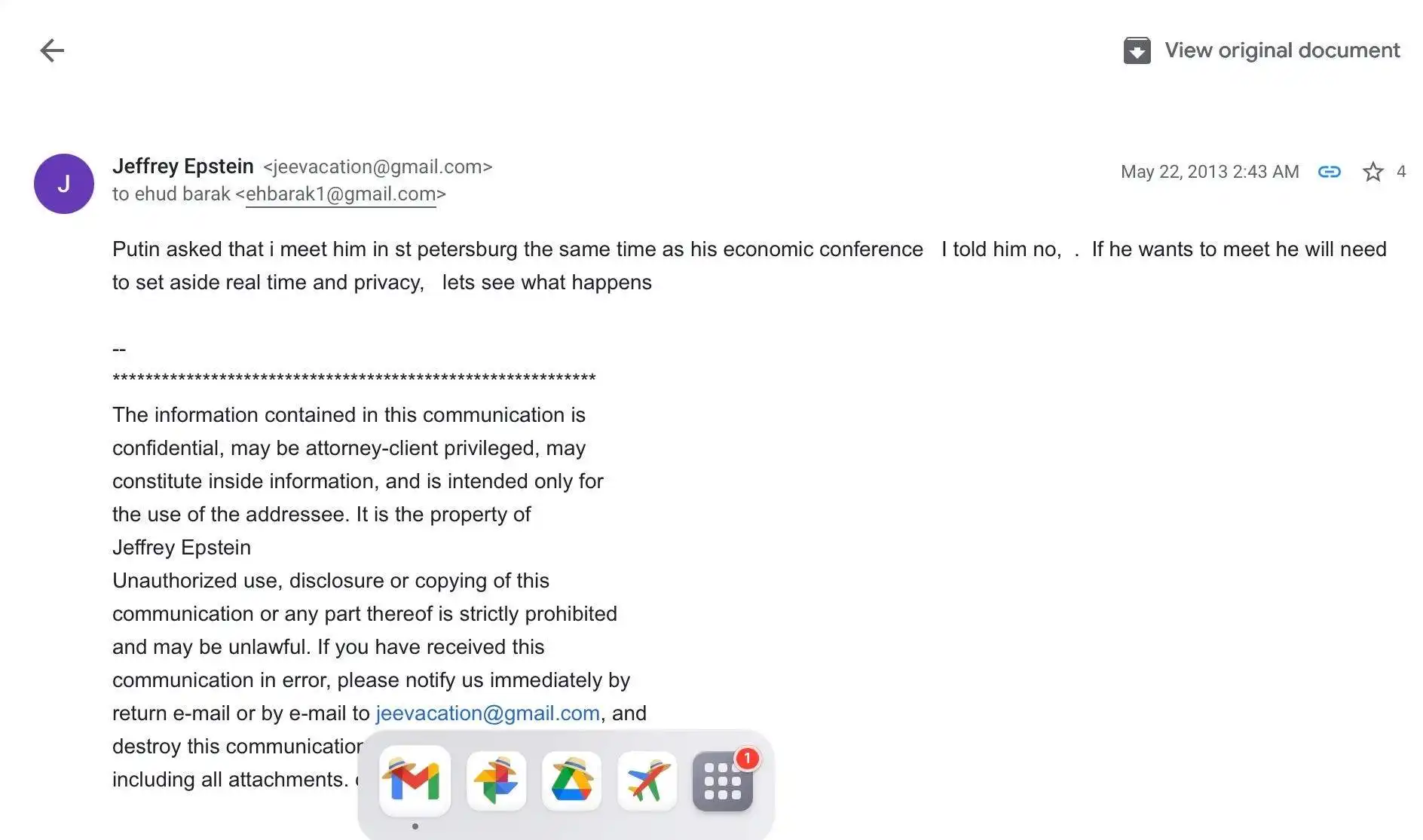
Caption: Clues to Epstein's relationship with the Kremlin
This was not baseless chatter. Epstein shared this information with former Israeli Prime Minister Ehud Barak, who was to meet Putin in person a few weeks later and could easily verify this claim through Kremlin channels.
In January 2014, Thorbjørn Jagland (then Secretary General of the Council of Europe) wrote to Epstein, stating he was planning to meet the Russian president in Sochi. Epstein told Jagland to 'explain to Putin that there should be a sophisticated Russian version of Bitcoin,' calling it 'the most advanced financial instrument globally.'
This is the prism through which to understand the rest of the crypto network built around Epstein, Vladimir Putin, Peter Thiel, and Steve Bannon.
Social Capital
Peter Thiel, co-founder of Palantir and a core member of the so-called 'PayPal Mafia' alongside Elon Musk, is an avid follower of cryptocurrency, valuing its ability to provide an alternative to government-controlled fiat currency. He once declared: 'Bitcoin is what PayPal should have been.'
He had long been a target of Epstein.
As early as 2012, Epstein received an email from fintech entrepreneur Ian Osborne suggesting they 'have a drink with Peter Thiel,' calling Thiel 'the best person to study currency,' and linking him to Abu Dhabi's sovereign wealth fund.
In 2013, Epstein urged former Israeli minister Ehud Barak to 'spend some real time with Peter Thiel.'
By July 2014, Thiel and Epstein were exchanging emails about Bitcoin regulation at the New York Stock Exchange. In September of the same year, Epstein hosted consecutive meetings with Thiel and William Burns, who was then Deputy Secretary of State in the Obama administration and is now the Director of the CIA (Central Intelligence Agency).
By 2015, Epstein proposed Thiel as one of the people Belyakov should meet. Following Epstein's advice, Belyakov contacted Thiel directly, and Thiel asked his executive assistant to schedule a face-to-face meeting for July 2015.
Epstein had multiple interests here. First was cryptocurrency. Emails from MIT (Massachusetts Institute of Technology) show that Joi Ito solicited and accepted donations from Epstein, which helped pay the salaries of Bitcoin Core developers after the Bitcoin Foundation collapsed. Another email thread shows Epstein was involved in the seed round financing of Bitcoin infrastructure development company Blockstream in 2014, increasing his allocation from $50,000 to $500,000 after Ito requested more shares in the oversubscribed deal.
But just as Thiel was interested in blockchain currency, surveillance, and data systems like Palantir, Epstein joined in, investing $40 million in Thiel's Valar Ventures. According to Ehud Barak, Thiel and Epstein 'co-owned' the firm and used it to take a share in the Israeli surveillance technology company Carbyne.
(A spokesperson for Peter Thiel later denied this, stating that Epstein was merely a 'limited partner (LP).')
As Epstein and Thiel aligned financially, their political inclinations also converged. Both were unusually important early supporters of Donald Trump's first presidential term. A brief exchange in the emails captures the tone of this relationship. Epstein wrote to Peter Thiel: 'I like your exaggeration about Trump, it's not a lie,' then suggested Thiel 'come see me in the Caribbean.'
Thiel broke with most of Silicon Valley, publicly supported Trump, and injected millions of dollars into pro-Trump super PACs. Epstein's communications show he closely followed Trump's polls against Hillary, campaign staff, and appointments related to Bitcoin and fintech.
In his speech at the 2016 Republican National Convention, Thiel used the platform of Trump's coronation to attack 'financial bubbles' and praise 'new forms of money,' later telling audiences that Bitcoin could be 'China's financial weapon' or a hedge against the dollar's reserve status.
As Russia's interference activities around the US election escalated through massive social media offensives and hacking of the Hillary campaign's emails, Epstein also arranged a luncheon at his New York townhouse, attended by Trump supporters Thiel, Tom Barrack, and Russia's Permanent Representative to the UN, Vitaly Churkin—a seasoned Kremlin operator.
After Churkin's sudden death in 2017, Epstein emailed Thiel: 'My Russian ambassador friend died. Life is short, eat dessert first.'
"Brexit is Just the Beginning"
Epstein was a frequent visitor to the UK, even beyond his connections to Ghislaine Maxwell and Andrew Mountbatten, and he closely watched British finance and politics.
In recently disclosed information and emails, he saw the UK's decision to leave the EU in the June 2016 vote as a political reshuffling and trading opportunity—something that could be shorted financially and leveraged politically. As he wrote to Peter Thiel about the chaos triggered by the referendum: 'Brexit is just the beginning.'
To achieve broader goals, beyond his maneuvers in Silicon Valley and Russia, Epstein invested significant time and intellectual capital in a major project led by former Trump campaign manager, White House Chief of Staff, Breitbart publisher, and Cambridge Analytica co-founder Steve Bannon, who had just lost his position as White House Chief of Staff and was looking for a new role.
He initially found opportunity in the pan-European populist 'Movement' (The Movement), founded in 2017 by allies like Nigel Farage's partner Laure Ferrari and People's Party leader Mischaël Modrikamen, initially led by Bannon's friend Nigel Farage himself.
Registered in Brussels, the organization's mission was to unite 'populist and conservative movements in Europe,' defending 'national sovereignty' and 'effective national borders.'
Behind the scenes, Jeffrey Epstein became a funder and strategist for Bannon's Movement, providing financial advice on how to circumvent financial regulations, offering transportation and accommodation, and introducing key figures in Europe.
During the turbulent Brexit transition, as Theresa May's government struggled to find a solution acceptable to the Brexit right wing, Bannon was flying to the UK to organize opposition.
In 2018, Bannon told Epstein he was meeting with Boris Johnson, Nigel Farage, and Jacob Rees-Mogg to organize them to overthrow Theresa May. Writer Michael Wolff wrote to Epstein, claiming to be an intermediary with leadership challenger Boris Johnson.
However, the UK was just one stop in Bannon's international populist plan. He soon texted Epstein about his broader European ambitions, claiming: 'My advisory role now covers Front National, Salvini's League, Germany's AfD, the Swiss People's Party, Orban, Land and Freedom Party, Farage—next May is the European Parliament election—we can increase from 92 seats to 200—block any crypto legislation or anything we want.'
By the time Theresa May was replaced by Boris Johnson in 2019, Bannon was ecstatic: 'May is gone... we really crushed them... we are on a roll.'
Even then, cryptocurrency never left the agenda, with Bannon agreeing: 'Crypto is currency, blockchain is equivalent to Internet 2.0.'
The Legacy of Crypto Politics
The UK left the EU in 2020. Epstein was arrested and subsequently died in prison. Farage's UKIP was replaced by his more domestically focused Reform UK. However, the lessons about fintech and its ability to reshape or disrupt democracy did not disappear.
When Farage's confidant, former UKIP MEP and Reform UK Wales leader Nathan Gill, was arrested in September 2021 on suspicion of accepting pro-Russian bribes, he was actually on his way to attend a Kremlin-backed forum on Russia's DEG electronic voting system.
He was scheduled to give a speech titled 'The Same Technology That Gives Us Crypto Will Also Change How We Vote,' explicitly linking blockchain to election infrastructure.
Subsequently, Farage's Reform UK became the first UK political party to solicit cryptocurrency donations through an overseas processor not fully regulated by the FCA (Financial Conduct Authority)—precisely the kind of opaque funding channel anti-corruption experts had warned about.
Meanwhile, Vice President J.D. Vance—whose Ohio Senate campaign was heavily funded by Thiel and who echoes Thiel's grievances against the 'Deep State' and globalism—is now at the core of Trump's plans as Vice President and the clearest advocate of national conservatism within the government.
Vance's rise implants Thiel's worldview into the executive branch: a politics that sees technology (from surveillance companies like Palantir to Bitcoin and other cryptocurrencies) as tools of national power and civilizational competition, rather than neutral infrastructure.
Against the backdrop of Epstein's 2013 Sputnik email to Moscow—urging Russia to 'reinvent the 21st-century financial system' by creating 'a new type of currency on a global scale'—the layers of the crypto-political project are exposed through Epstein's documents.
Although Epstein is no longer alive, the cryptocurrency infrastructure he helped save, Silicon Valley's ideological resistance to regulation, and the dark, unaccountable influence of crypto politics in democratic elections remain some of his most destructive legacies.
Updated on February 5, 2026, to include comments from Thiel's representative regarding Epstein's role in Valar Ventures.